Mineral options
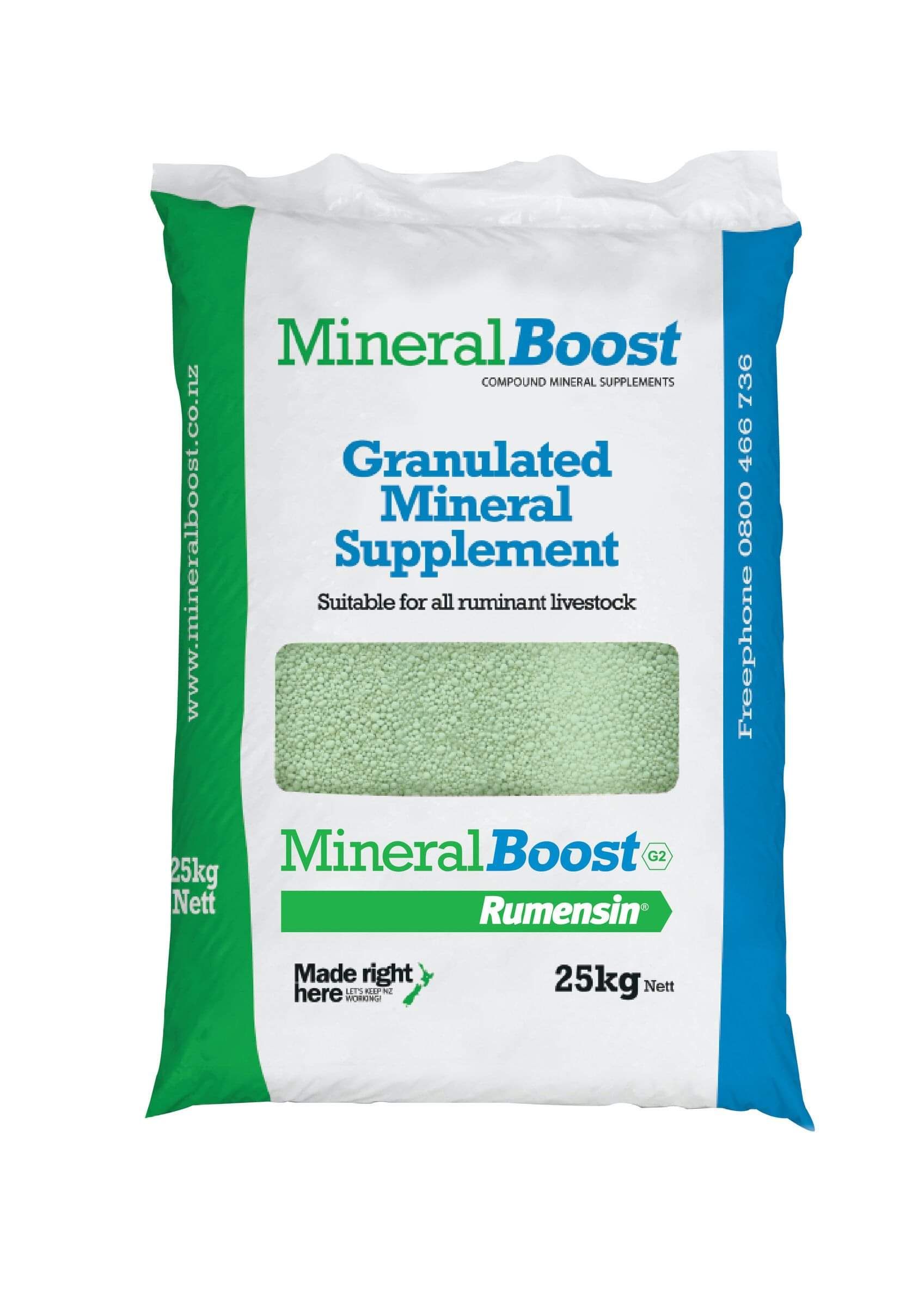
MineralBoost Rumensin®
The trusted option to help combat bloat and ketosis.
Feeding recommendations
MineralBoost Rumensin® contains all the benefits of MineralBoost Classic with the added advantage of Rumensin® – designed for early-mid lactation to help combat ketosis.
Each and every granule of MineralBoost has the exact ratio of the materials required within the formulation. Granules are easy to measure and blend. Salt in each granule means it's palatable for animals. Accuracy counts.
Rumensin® is an ideal ingredient for lactating and dry cows. Rumensin® is a scientifically proven rumen modifier that improves the health and performance of dairy cows. Rumensin® aids in controlling ketosis, reducing bloat and both preventing and controlling coccidiosis caused by Eimeria zuernii and E. bovis.
Each 200gms contain
Calcium | 48 gms elemental |
Magnesium | 10 gms elemental |
Sodium | 10 gms elemental |
Ionophore | 300 mg per cow, per day |
Good for
Bloat
Coccidiosis
Ketosis
Sodium Deficiency
Nutritional Benefits
Rumensin® is an ideal ingredient for lactating and dry cows that increases milk protein production under many conditions.
Rumensin® is a scientifically proven rumen modifier that improves the health and performance of dairy cows. Rumensin® has a number of proven benefits including increased milk protein production. In addition, Rumensin® aids in controlling ketosis, reducing bloat and both preventing and controlling coccidiosis caused by Eimeria zuernii and E. bovis.
The rumen dispersible granule is a patented delivery technology designed to exhibit the benefits of a granule during mixing and freight (less dust, less segregation, less waste), while dispersing into super-fine powder once inside the rumen - providing a very convenient method of adding essential nutrients to an animal's diet.
Want to find out more?
Contact your local TSR or the Nutrinza sales team.
Feed storage on farm
As with any grain or meal feed, products need to be kept dry, as moisture combined with heat can cause fungi to grow. Common on-farm storage methods are: in a shed or unused fertiliser bin; in a covered pit; on a concrete pad; or in a cutting, covered with a plastic sheet and tyres. Most feed should be used reasonably expediently (within 40 - 50 days). The longer you plan to store feed products, the better your storage facilities need to be.
P. 0508 768 723
PO Box 370,
Te Awamutu 3840
E. [email protected]
Disclaimer
All animal feed products should be fed as part of a healthy balanced diet matched to the specific requirements of the herd. Nutrinza makes no representations or warranties of any kind, express or implied, as to the suitability of any of the products supplied to the specific requirements of your animals. Please note that recommended feeding rates are given as a guideline only and will vary based on the total diet and actual feed intake of your animals. It is recommended that you consult your vet, nutritionist or farm consultant before making any dietary changes. Nutritional information is based on accredited feed nutrition sources and sample test results. Specifications on an individual feed test will show some variation.